The Manger, The Table, and Hospitality as Worship.
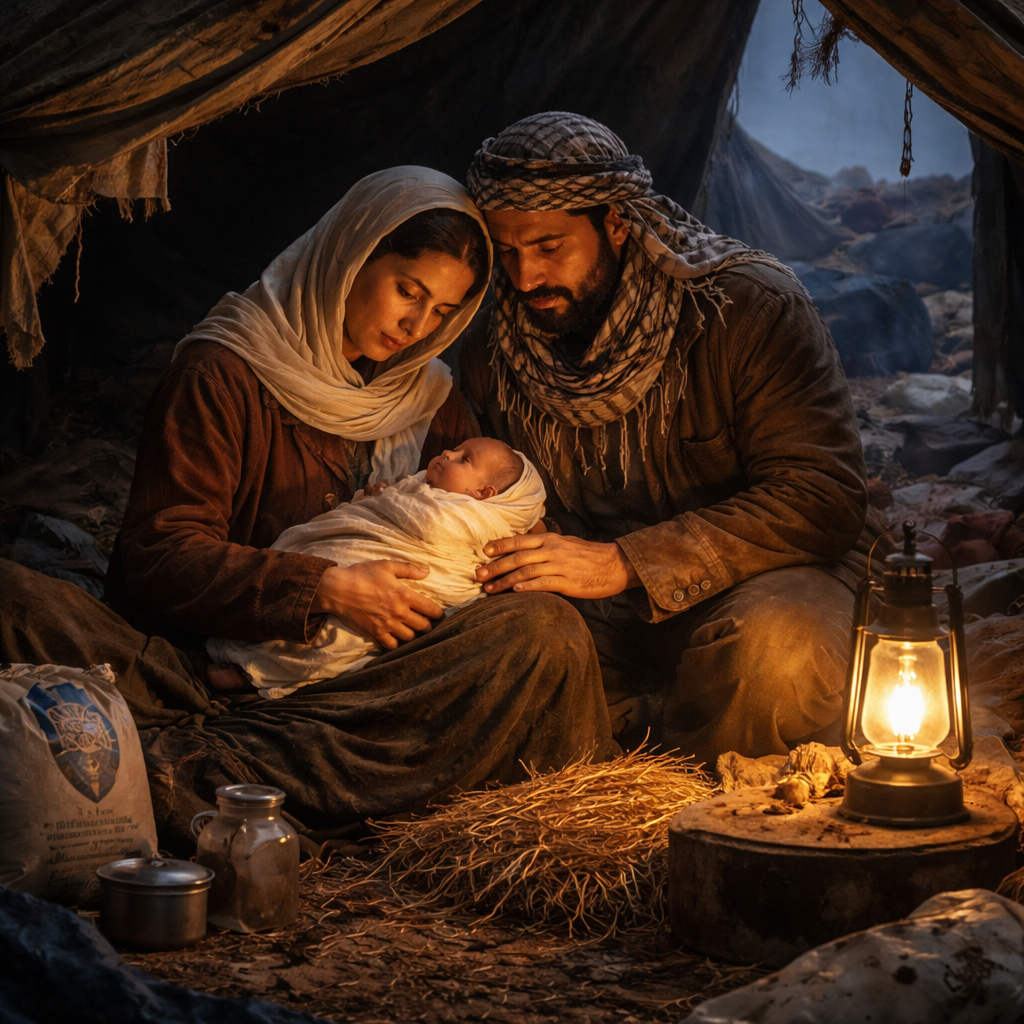
Image produced by ChatGPT 5.2
Christmas Reflection, 2025
The first thing our Lord inhaled in this world was the odor of drying dung, sour milk, and wet hay pressed into splintered wood. He first lay His head not on a soft bed but in a pile of hay—dry, cutting, and filthy—protected only by a layer of swaddling cloth that his mother and father wrapped Him in. Before he ever uttered a human word, He allowed Himself to be laid among animals. When Catholics think about the body of Christ, we imagine gold-laden monstrances, chalices, and patens, sweet smelling incense, the lavish rituals of water, bread, and wine—all good, yes. But this is in stark contrast to that first tabernacle that was the manger where our infant Lord took His first rest.
It is easy for us to get sentimental about Christmas. And that is good. Christmas is a time to be with family, to exchange gifts, and to bask in the warmth of loved ones gathering together. I am sure in the coming days many of us will spend hours on end preparing food and home for guests that will travel a few blocks to many miles to reunite. This is all good and it is right. This Christmas, I want to meditate with you all on the virtue of hospitality, and its centrality in both the story of salvation—from Genesis to the last supper—as well as a core message of the Nativity story itself.
But to shift away from the sentimentality that we are accustomed to associating with this feast of the Church, let us remember that what we do in church this Christmas is not simply a celebration of Jesus’ birthday, but a solemn commemoration and act of supplication before the very God who found it pleasing to save sinners by dwelling among us in our decadent condition, flesh and all. It is a scandal! This is what our Jewish and Muslim brothers and sisters plainly deem to be anathema in our religion: that the almighty and infinite Creator of the Universe would not only come among us, but become one of us in our finite, corruptible, and decaying bodies. What a scandal it is indeed! But again, what good love story can resist such a scandal?
Current biblical scholarship notes that there are two stories which do not align properly with the historical or archeological record. The first is the reality of whether or not Jesus was born into a manger – a trough for farm animals to eat from. The second is whether or not the holy family ever then had to flee into Egypt because of Herod’s mandate to slaughter the innocents.
I know—it is quite the rhetorical choice for me to introduce holes in the plot when I’m trying to defend the message, but bear with me. These two contested stories about the infant Jesus also do not exist together, but are found in Luke’s and Matthew’s Gospels, respectively. It is also important to note that the Gospel of Luke and the Gospel of Matthew are the only Gospels to chronicle the nativity. So it is interesting to suggest that for whatever reason, the authors of these nativity stories invented these plot lines. Beyond the question of historical accuracy, what I would suggest to us today is that the more important question is, why invent these stories?
I believe it is likely that there is a crucial lesson that the evangelists wanted to place front and center in the story of the infant Jesus. In order to understand why, we have to understand the what of that lesson. The virtue of hospitality is deeply entrenched in semitic cultures. In Ancient Mesopotamia, there are stories of Babylonian Gods who would wander disguised as strange travelers as a test of the people’s hospitality. Mistreating a guest then risked offending a god. In the pre-Islamic world of the Arabian peninsula, hospitality, or ḍiyāfa, was among the highest of virtues such that the honor of a host depended on the extent of his generosity towards strangers. We can still see remnants of this today in our friends who come from these regions of the world. Have any of us ever gone to an Arab’s house? You will drink tea and eat until your bellies force you to stop! In fact, I am told that in Islam it is considered a sin to even refuse food or water to one who asks for it.
In our own tradition, we see this virtue reflected in the stories of the Ancient Jews. One of the earliest times in the bible that we see God wipe out an entire civilization by his own hand is in Genesis 19, where Sodom and Gomorrah suffer for their violent inhospitality to the heavenly strangers that visited them. In the Old Testament, this is a cataclysmic event, and is central to the way that the apostles understood their own heritage. This is just one such story among many in the Old Testament that highlight the primacy of hospitality among the virtues of Jewish religion.
It now becomes clear that this is a plausible motivation for the authors of Luke and Matthew to include the details of the wandering from inn to inn, and the manger, and the flight into Egypt in their narratives. They wanted to situate God as a stranger in a foreign land just as the angels who arrived at Sodom. In Luke’s Gospel, Mary and Joseph can find no room in the inns of Bethlehem to welcome their son. We are confronted with humanity’s great vice: inhospitality. And even still, Luke wants us to understand what an offense it is that the Lord of the cosmos allows himself the indignity of being born among beasts and shit.
God came to save us by taking on our flesh—raising our nature to the dignity of his own. And yet just as He came into this world as flesh and blood, He was turned away by the same flesh and blood that he assumed. So entrenched in our sinful estate He was, that he allowed himself this indignity; so rejected by the humans he came to save, that he was more likely to find welcome among the beasts of the field and their squalor, even when they could not comprehend His majesty. And still, he stays.
What Luke is showing us here is that God assumed the fullness of our fallen estate and our needs. Jesus too needed the safety of shelter, the nurture of warmth, the comfort of sleep. Even further, Matthew shows us that Jesus needed protection from violence, and had found safety in new lands. However in this dialectic of gift and exchange, as Jesus humbled himself to share in our humanity, we become dignified to share in his divinity. In this way human flesh becomes elevated and sanctified, and hospitality then is not mere virtue, but worship—sharing in the inner life of God.
This thread runs through the Gospel, as Jesus eats with strangers, comforts the sick and weary, feeds the hungry, and visits the homes of sinners. Jesus is the pattern of hospitality; the master host. In a poignant way, we see this again in the Gospel of John when Jesus hosts the passover meal with his disciples. In John 13, we have the scene where Jesus washes the feet of his disciples. This was an act of humility so beyond Him that Peter protested, reproving Jesus saying that his master would not wash his feet! Yet, Jesus, wrapped in the waist towel of a servant, washes Peter’s feet, and all of his disciples' feet, in a profound act of humility, reserved for household servants at the behest of the hosts.
Here, hospitality becomes service, and moreover, it is bodily. Jesus touches the feet of his disciples; he washes them as children of his own, and then he feeds them. What we see here—in this prologue to the Last Supper—is a liturgy of hospitality: love made visible in the body, providing for the needs of the other, and raising them into the dignity of the life of Christ. Here, at the end of his life, Jesus offers and elevates the dignity he was refused at its start. And giving them the mandate to love as he has just loved them, to wash, to feed, to clothe, to visit, to house, to heal, and to comfort become acts of worship. Hospitality is worship par exemplar. It is why Jesus designed that the pinnacle of worship take place at a meal at a table among family and friends. It is why our temples are tabernacles, or little inns. It is why we keep holy water at our doorposts for our guests, and why we have food pantries, and bereavement committees, and ushers and greeters. It is why worship happens not only in a temple, but in houses of God.
To welcome and to care for those, even to take them into our own homes as we do the house of God Himself, is to partake in heavenly worship. And likewise, to turn away, to displace, to exile, to withhold shelter, food, and medicine is antithetical to the life of Christian worship.
St. Benedict of Nursia thus instructs his monks: All who visit the monastery are to be welcomed as Christ. Not as though they were Christ, but as Christ himself. Our homes, our land, are meant to be witnesses to this instruction. We are to be welcoming inns, more than a manger, to those who visit us—to welcome, house, feed, and comfort those who share in the dignity of the humanity of Christ who assumed our flesh despite our sinfulness. It is an act of gratitude to God—an act of divine worship—to care for one another in this way.
So, as we remember and reflect on the mystery of the incarnation and the nativity of our Lord, let us be mindful that what we are called to in this mystery is to be a people that welcomes all as Christ. We are to be a home of welcome for all our brothers and sisters, all children of the Father, all pregnant with the humanity we share with Jesus Christ.
Merry Christmas.