Oil and Authority: What the SSPX Moment Exposes About Episcopal Ordination
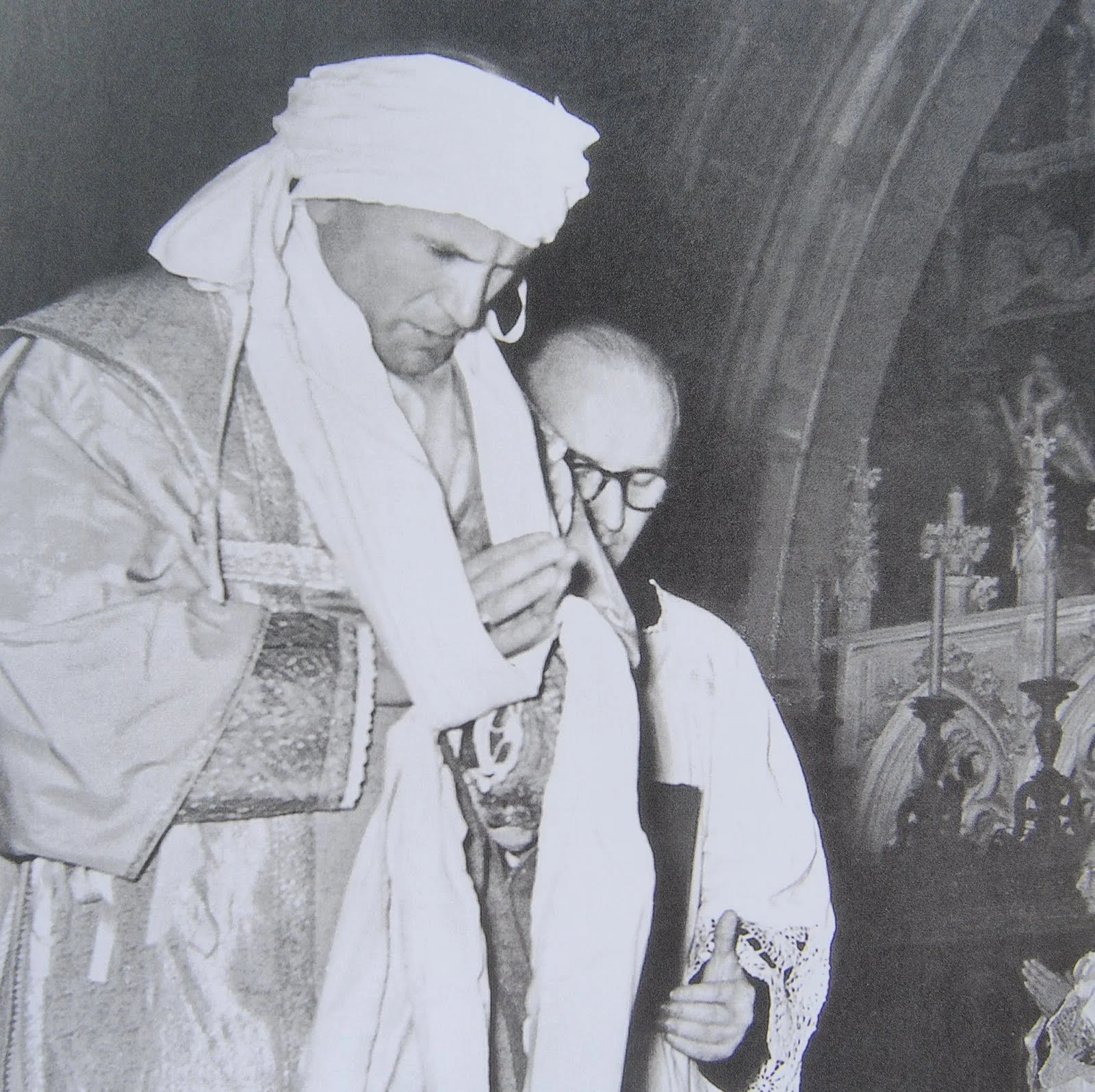
Photo from the episcopal consecration of Carol Wojtyla, the future Pope John Paul II.
Preface
On the Terms of This Argument
This essay is not an intervention on behalf of the Society of St. Pius X, nor is it an argument against the legitimacy of post-conciliar reforms as such. It does not dispute the validity of the Novus Ordo, question the authority of the Second Vatican Council, or suggest that the contemporary episcopate is illegitimate. Readers looking for another iteration of the familiar traditionalist critique—focused on rupture, licitness, or resistance—will not find it here.
Neither, however, is this an argument against tradition, ritual inheritance, or the older forms of the Church’s sacramental life. On the contrary, it takes tradition seriously enough to ask what those forms did to the people who passed through them, and whether contemporary rites continue to do comparable formative work. The concern animating this essay is not juridical but anthropological; not about whether the Church may reform her rites, but about what kind of ecclesial subjects those reforms quietly produce over time.
If this essay sounds critical, it is because it treats ritual not as decoration or preference, but as pedagogy. Rites teach before they explain. They form imaginations before they transmit propositions. To notice that some forms train authority, sacrifice, and responsibility more forcefully than others is not to deny the Church’s authority to change them. It is to insist that such changes are never neutral.
This essay is written from within the Church, not against her; from within tradition, not in flight from it. Its wager is simple but demanding: that the deepest crises of belief are rarely solved at the level of doctrinal assertion, because they begin at the level of formation—long before anyone knows what words to argue over.
The Society of St. Pius X (SSPX) has announced its intention to again ordain bishops for its community without papal mandate. The risk of excommunication is again on the horizon, and Catholics on both sides of the aisle find themselves discussing sacramental validity, licitness, and authority in regards to the traditional rites of the church as well as the future of these rites given the contemporary papal positions on the matter. As something of a traditionally minded Catholic myself, my anxiety about the contemporary Church is not, finally, a question of validity. I do not believe the sacraments have failed, that apostolic succession has been broken, or that the Church has quietly slipped into ontological incoherence. Those claims are too crude, too impatient, and — despite their traditionalist posture — too Protestant in their underlying logic. My concern is subtler and therefore more dangerous. It is not about whether the sacraments work, but about whether we are still forming people capable of believing what the sacraments claim to do.
This is why my concern does not settle primarily on the Novus Ordo Mass. Whatever its aesthetic failures, banal executions, or cultural unevenness, the post-conciliar Mass remains theologically coherent. It says what the Church believes. My unease lies elsewhere — at the level of formation, imagination, and affect. It lies in the slow erosion of pathos, the ritual weight that teaches belief to settle not first in propositions but in bodies.
Rites do not merely express doctrine; they train subjects. They teach people, often long before they can articulate it, what belief feels like. If lex orandi, lex credendi is true — and it is — then it must be understood not as a claim about textual orthodoxy but as a claim about embodied plausibility. How we pray is not merely expressive of belief; it is formative of the believer. And this is where the fault line truly runs.
The most consequential site of this formation is not the parish altar but the episcopal throne.
Historically, the ordination of bishops has been among the most symbolically dense acts the Church performs. This is not accidental. The bishop is not simply another minister elevated by degree. He is the successor of the apostles, the high priest of the local Church, the guarantor of unity, and the living locus of sacramental authority. If the Church truly believes that bishops inherit the weight borne by those who laid hands on Timothy and Titus, then the rite that makes a bishop should feel less like a commissioning and more like a seizure.
The older rites understood this instinctively. They were startlingly ancient — not merely traditional in the sense of being old, but ancient in a way that felt almost pre-Christian. Chrism was not sparingly applied but lavishly poured. Heads and hands were bound, not symbolically but physically. Woolen cloth wrapped skin still slick with oil, restraining the newly consecrated from returning too easily to ordinary life. The language was not managerial or explanatory; it was declarative, asymmetrical, and grave. Something irreversible was happening, whether the man felt ready for it or not.
What these rites communicated was not first what a bishop does, but what he has become. They spoke in the grammar of the Hebrew Scriptures, not the language of modern institutions. One could not watch such a consecration without thinking of Samuel anointing Saul, or Elijah casting his mantle over Elisha. In Scripture, anointing is never benign. It is dangerous. It confers responsibility before it grants understanding. It marks a man in a way that continues to judge him long after the oil has dried.
The binding of hands and head is the detail that reveals the logic most clearly. Binding is sacrificial language. Victims are bound. Priests are bound to the altar. Kings are bound by covenant. To bind a bishop’s hands after anointing them is to say, without apology, that his agency is no longer his own. His thoughts are no longer private. His power has limits precisely because it now belongs to God. Authority, here, is not something one wields comfortably; it is something one survives.
None of this renders the post-conciliar rites invalid or doctrinally defective. The Church has the authority to revise her rites, and she has exercised that authority many times across history. The issue is not theology but formation. When symbolic density is thinned — when ritual language shifts from ontological declaration to pastoral explanation, from divine seizure to communal affirmation — the rite still works, but it works differently. It forms a different imagination, one in which authority is intelligible before it is fearsome, and service is emphasized before judgment is impressed.
This matters because sacramental belief is not sustained by explanation alone. Sacrifice, in particular, requires a felt seriousness. One can state, correctly and repeatedly, that the Eucharist is a true sacrifice, the re-presentation of Christ’s self-offering to the Father. But if the Church’s highest priest in a given place does not experience himself as having been seized, bound, and burdened by something prior to and greater than himself, then the sacrificial language of the Mass begins to sound symbolic rather than dangerous.
Here is the point that cannot be evaded: sacramental confidence flows top-down, not bottom-up. You can survive liturgical incoherence at the parish level. You cannot survive prolonged incoherence at the level of episcopal self-understanding. Bishops do not merely oversee the sacraments; they authorize their seriousness. If a bishop experiences himself primarily as a supervisor of clergy, a mediator of factions, or a manager of institutional risk, then even perfectly orthodox sacramental language begins to lose its existential force.
How can one credibly catechize the faithful into believing that the Mass is a true sacrificial meal — costly, dangerous, and real — if the high priest of the local Church does not experience his own ministry as anything more than administrative oversight? This is not an attack on bishops’ intentions or personal holiness, nor is it meant to diagnose any particular instance of episcopal failure. Rather it is a conjecture meant to bridge two positions that have failed to engage charitably: progressives who dismiss concerns about ritual thinning as mere aesthetics or nostalgia, and traditionalists who interpret weakened sacramental confidence as proof of doctrinal rupture. The conjecture is an anthropological claim: belief becomes fragile when ritual no longer forms people capable of bearing its weight.
This is precisely where my argument diverges from that of the Society of St. Pius X. The SSPX correctly senses that something affective and symbolic is at stake in the Church’s post-conciliar life. Where it errs is in locating the problem in legitimacy rather than formation. It treats weakened sacramental confidence as evidence of doctrinal rupture, and thus responds with acts of defiance framed as fidelity.
My argument makes no such claim. I do not believe the Church lost her authority to reform her rites, nor that Vatican II introduced theological incoherence into sacramental theology. What I am arguing is far more unsettling: even valid sacraments can become unbelievable if their ritual ecology no longer forms subjects capable of believing them. This is not a canonical problem, and it cannot be solved by reassurances about validity. It is a cultural and anthropological problem, and it must be named as such.
When the Church’s ritual language no longer confronts men — especially bishops — with the terror and promise of being seized by God, authority becomes lighter. And when authority becomes lighter, it compensates either by retreating into silence or by reasserting itself through policy and procedure rather than presence and fatherhood. Neither mode communicates sacrificial reality. Neither teaches the faithful that something irrevocable is at stake.
What I am defending, then, is not nostalgia for older forms as such, but the claim that pathos is not optional in sacramental life. Doctrine requires atmosphere to survive. Catechesis requires a ritual culture that renders belief plausible before it renders it articulate. The older episcopal rites did not merely teach theology; they produced men who could not forget, in their bodies, what they had become.
The Church does not lose her apostolicity because rites change. But she does risk losing her capacity to catechize into sacramental realism when those rites no longer impress the cost of authority upon those who bear it. My concern is not that bishops today lack goodwill or orthodoxy. It is that we have asked them to carry apostolic weight without first binding their hands tightly enough to remind them that the weight is not theirs to set down.
In this sense, the crisis we face is not doctrinal but somatic. It is not about what the Church teaches, but about whether she still knows how to teach belief through the body. Culture is downstream from formation, and formation is downstream from ritual. If we want a Church capable of sustaining sacramental faith, we must attend carefully — and honestly — to the rites that tell her leaders who they are.
The ancient Church understood this. The Hebrew Scriptures assumed it. My argument is simply that we would be wise to remember it again.
Coda
Sacrifice, Exposure, and the Weight of Responsibility
Although this essay has deliberately avoided philosophical jargon, its instincts are unmistakably shaped by a particular ethical grammar—one that understands responsibility as prior to consent, and obligation as preceding explanation. The concern here is not merely that sacramental language has softened, but that ecclesial authority has become insufficiently exposed to the weight it claims to bear.
In this sense, the loss of ritual pathos is not primarily an aesthetic failure but an ethical one. Sacrifice, properly understood, is not spectacle or violence but exposure: being placed irrevocably in a position of answerability one did not choose and cannot escape. The older episcopal rites enacted this exposure bodily. They bound hands, saturated skin, and imposed silence before speech. They did not explain responsibility; they inflicted it. A man emerged not clarified, but burdened.
Modern ecclesial culture often assumes that responsibility is best taught through transparency, explanation, and collaborative process. There is truth in this. But ethical gravity is not born of comprehension alone. It arises when the self is interrupted—when authority is experienced not as empowerment but as vulnerability before the other and before God. A bishop who has not been ritually interrupted in this way may still govern well, teach orthodoxy, and love sincerely. But the Church should not be surprised if sacrificial language begins to feel metaphorical rather than dangerous when those who authorize it have not themselves been placed, bodily and symbolically, under its weight.
What is finally at stake, then, is not nostalgia for a lost past but the Church’s capacity to form subjects capable of infinite responsibility. The crisis described here is not doctrinal but ethical; not semantic but somatic. It asks whether the Church still knows how to create leaders who experience authority first as exposure, priesthood first as burden, and sacrifice first as something one survives rather than manages.
If the Church wishes to sustain sacramental belief in an age increasingly suspicious of transcendence, she may need less explanation and more interruption. The ancient rites knew this. They did not persuade; they marked. They did not clarify; they bound. Remembering this may not solve every ecclesial tension—but forgetting it has already proven costly.