Blessed are you, on the path, and in the promise.
A Sermon for Beatitude Sunday
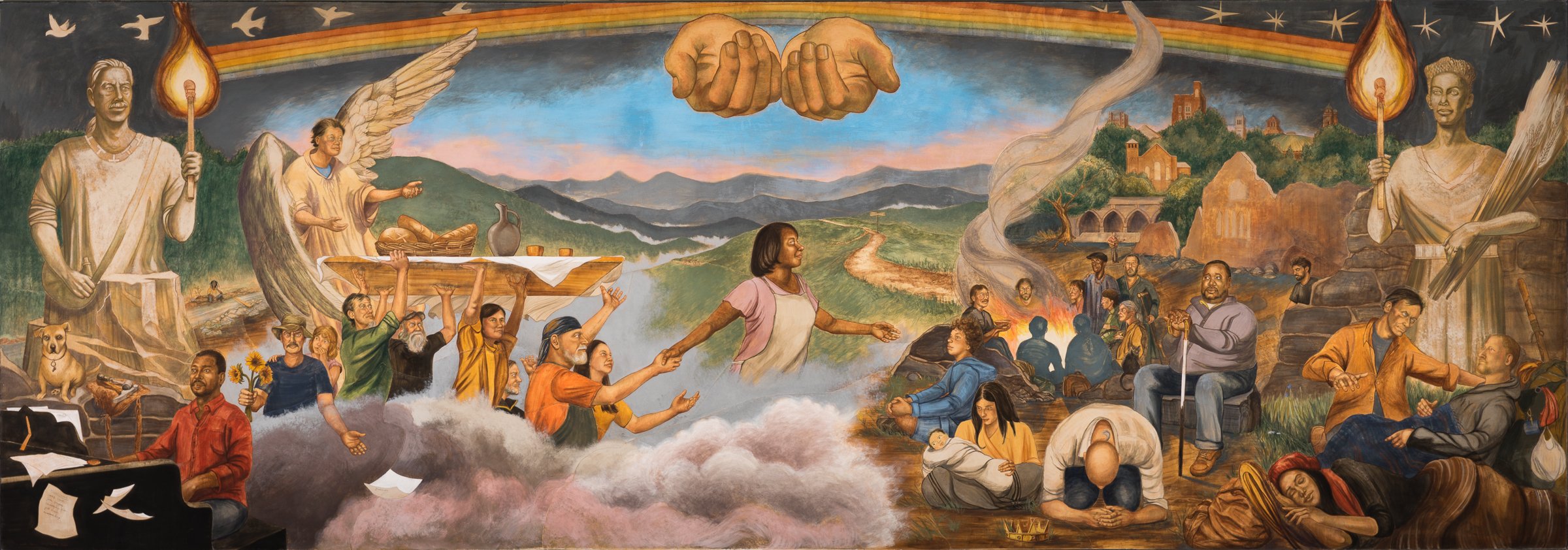
Christopher Holt (American, 1977–), Haywood Street Beatitudes, 2018–19. Fresco, 9 1/2 × 27 ft. Haywood Street Congregation, Asheville, North Carolina. Photo: John Warner.
Dear brothers and sisters,
Let us hear the words of the Gospel that begin the story of the sermon on the mount:
“Large crowds from Galilee, the Decapolis, Jerusalem, Judea and the region across the Jordan followed him. Now when Jesus saw the crowds, he went up on a mountainside and sat down. His disciples came to him, and he began to teach them.” (Matthew 4:25-5:2, NIV)
Jesus was traveling through Galilee beginning his public ministry. He called his first disciples, he healed the sick, he began his preaching, and he was gaining notoriety. Matthew’s Gospel is quick to tell us that crowds from all over came to listen to him: Galilee, Jerusalem, the Decapolis… these alone showing the vast variety of people who were drawn to Him: Jewish people from the country-side, those from the bustling heart of Jerusalem, even non-Jews from the Decapolis.
Notice what Jesus does here. Jesus is being Jesus, and doing Jesus things, and people of all backgrounds and experiences feel an affinity towards Him. And Jesus knows what they want from Him, and so he finds a place on the mountainside where they can all gather and listen to him preach. As Peter later on announces, here we already see revealed: people come to Jesus because he holds the words of eternal life. And they come—out of longing, need, or curiosity—to hear these words.
And Jesus begins by doing something interesting: he offers a list of the sorts of people God gives His blessings to.
We know how these go… and if you went to Catholic school back when I did, you remember crying at home trying to memorize the Beatitudes for your religion test the next week.
“Blessed are the poor in spirit, for theirs is the Kingdom of heaven.
Blessed are those who mourn, for they will be comforted.
Blessed are the meek for they will inherit the earth…”
And the list goes on.
I wonder how many of us have heard this sermon of Jesus’ year after year—at Mass, at bible studies, or in your grandparents’ car radio tuned permanently to Family Radio—and always considered that this was sort of the playbook that Jesus offers us to get to heaven.
In fact, Fr. Mike Tedone, who was the parish vicar at Our Lady of Lourdes in Queens Village where I was churched as a child, always taught us that we should think of the beatitudes as “attitudes of how to be.” (Retrospectively, there are grammatical problems there but they don’t matter all too much; because we get the point.) The idea that I think a lot of us understood from the Beatitudes is that these are the proper dispositions towards life that are conducive to holiness. And to an extent, I think that is correct. These dispositions are—by the promise of the word of God—blessed, and so are holy.
But I also wonder how many of us—especially those of us who have been entrenched in the pathos of the church—hear this roadmap alongside Jesus’ other teaching, “Be perfect as your Father in Heaven is perfect.” I wonder what that does for a lot of us.
I think that both of these things are true, but I often wonder how much more seriously we might take this—and with how much more peace we might receive this—if we understood something that might ease the anxieties many of us might have about religion.
So before I continue, I want to offer us this sentence to sit with, and to rest with: Perfection is not the path to heaven, it is the goal attained there.
Let that settle.
I know that all of us, each of us, struggle with our vices. Some of us struggle with anger, many of us struggle with lust. Many of us are self-indulgent and many of us hoard our goods. Even many of us struggle with hate, and some of us struggle with life itself. Jesus knows that.
Jesus knows that some of us work 60-70 hours a week to put food on the table for our families but somehow always come up short. He knows that some of us have loved ones who are supposed to be in the prime of their lives but are otherwise at the brink of death at the hands of cancer or addiction. God knows some of us have partners we love deeply but cannot love enough because pornography gives us an idea of ourselves that replaces the one we can’t stand in real life. God knows that our sins are born of the illness that is the fallen, human condition. And God sees us in that condition and speaks a word over us: You are blessed.
What we must take seriously is that Jesus is not here merely a teacher reporting to us what God thinks about people, or what sort of people God will bless. Jesus is God. So when he opens his mouth on that mountainside, God is not describing blessings from a distance; it is the mouth of God speaking these blessings—actively; over those people; in that moment.
Notice that God doesn’t say, “become poor in spirit.” He says, “You who do not have the strength, you are blessed.”
He does not say, it is better that you mourn, he says, “You who grieve, you are blessed.”
He doesn’t say, “become meek,” he says, “you who have been worn thin, you too are blessed.”
Allow me to go on. He says:
“You who long for holiness but still struggle in your sin: you too are blessed.”
“You who forgive when others still hurt you: you too are blessed.”
“You who are hurt because your hearts have not hardened: you too are blessed.”
“You who cannot fight, but who choose peace instead: you too are blessed.”
“You who are injured, spoken ill of, and reviled, all because you have chosen me: you too are blessed.”
Jesus called together a vast crowd of varied people, drew them all to a mountain, and spoke to them where they are: entrenched in the human condition.
You see, the anxiety I want to calm in us is this idea that we need to be perfect here in order to be happy over there, in heaven. And that is not the case. What Jesus is telling his followers on the mountain is that the road to heaven is not a one-size fits all deal. And even though his words are spoken to the public, what God always does is address the individual. So while the beatitudes are given to us all, and yes, they do offer us an idea about the sorts of dispositions that God finds with favor, consider that as a prologue to his sermon on the mount, what Jesus is doing here is prophetic and priestly par excellence. He calls a variety of vastly different people to the mountain, and greets them with a blessing: “Blessed are you, all of you, my people, wherever you find yourself. Come, and receive me.”
And he is doing that again today. When you are at Mass, take a look at your fellow Christians. Look at how many individual, different histories have been summoned to the altar—the high place, the mountain—by Jesus whose promise endures. He calls us again to his mountain, right here and now, today and always, and he speaks blessings over us. He says, “Sing and rejoice, O daughter of Zion, for behold, I come and I will dwell in your midst!” (Zechariah 2:10)
Rejoice, people of God, for your God has found favor with you. And while our many paths may be different, we have been called to them by a God who loves us, and finds favor beyond measure with us. And in gratitude and love, let us stay faithful to the God who has loved us, who has called us, and who speaks blessings to us, and walk faithfully with him, transformed in His presence, until we are with our Father in heaven. Because perfection is not the path we must walk, but the promise we have been given.
+ In the name of the Father, the Son, and the Holy Ghost. Amen.